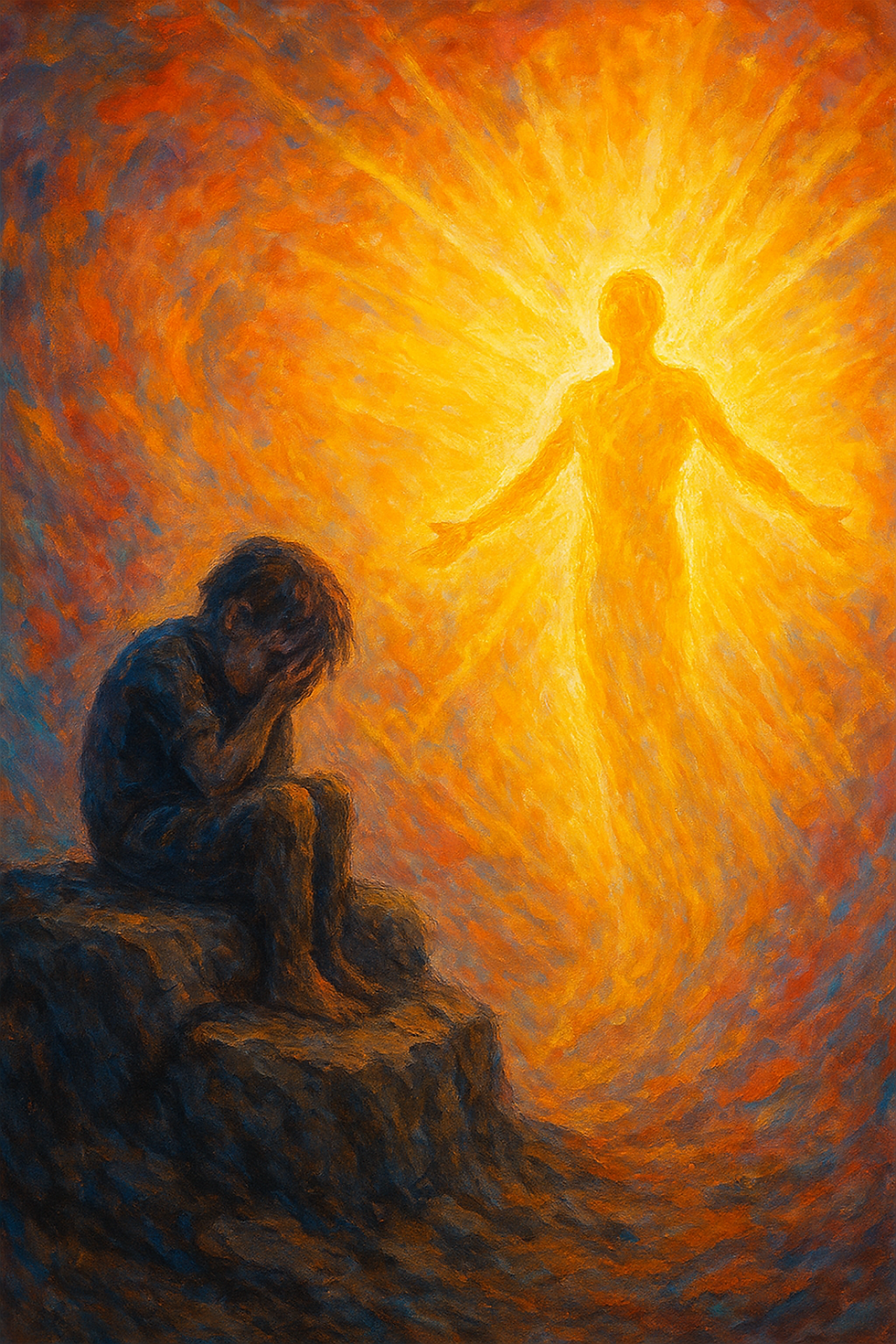
Psychological Impact of Emotional Pain. How to Face It.


The Psychological Impact of Emotional Pain—How to Face It When It Hits All at Once
When pain hits you like a tsunami, it does not arrive politely. It does not knock, introduce itself, or wait for the room inside you to be ready. It comes with the force of everything you did not know you were holding back.
One moment, you are still standing inside the familiar architecture of your life, arranging thoughts, making sense, keeping yourself composed, trying to remain reasonable, and the next moment something enormous rises from beyond your control and covers everything.
The mind goes silent, not because it has found peace, but because its usual authority has been swallowed. There is no strategy in that moment. No elegant lesson. No explanation capable of standing upright. There is only the impact. The body understands before language does. The chest tightens. The breath becomes strange. Time loses its ordinary shape. What was solid a moment ago becomes unreachable, and you realize that pain is not only an emotion.
Too Much and Too Close
Pain is an atmosphere. It changes the weather of the entire inner world.
And perhaps the most unsettling part is not that the wave comes. It is that for a moment you cannot remember who you were before it. Pain erases proportion. It makes one hour feel like a lifetime and one memory feel like a sentence.
It pulls you beneath the surface of yourself and shows you how much of your strength was built on conditions: as long as things continued the way you expected, as long as you could anticipate what comes next, as long as the version of life you understood remained intact, as long as the ground beneath you continued pretending to be ground.
Then the wave comes, and all the hidden dependencies are exposed. Not to shame you. Not to punish you. But because pain has no interest in your performance. It does not care how composed you looked. It does not care how much you understood intellectually. It reaches for the places where you were still negotiating with illusion and floods them without apology.
When Roles Fall Away and Nothing to Make Sense of This
There is a strange violence in being forced to meet yourself without the structures that used to hold you together. The roles disappear first. The competent one. The patient one. The one who can endure. The one who turns suffering into meaning.
Under great pain, even meaning can feel misplaced when it arrives too quickly.
You do not want someone to tell you that everything happens for a reason when you are still trying to breathe. You do not want explanation placed over the wound like decoration.
There are moments when the only honest thing is to admit: this hurts beyond the language you have for it. This has entered you in a place you did not know could break.
This has taken you somewhere you cannot explain without making it smaller.
But the wave, for all its force, also reveals something exact. It shows you what was never truly anchored. It shows you where you were standing on borrowed ground, where your stability depended on continuity, predictability, or the assumption that you could hold everything in place.
It shows you the quiet contracts you made with life without realizing you had signed anything. I will be okay if this remains. I will be safe if nothing shifts. I will know who I am as long as this structure holds.
Then the water rises, and the contract dissolves. And what remains is unbearable at first because it feels like emptiness. But sometimes what you call emptiness is the first space that has not been occupied by attachment, fear, performance, or waiting.
This is why pain can feel like something ending before it becomes anything else. Something in you is actually ending, but not always the thing you think. Often it is not your capacity to feel. Not your ability to care. What ends is the arrangement you built around the need to feel stable.
The assumption that stability could be secured through holding things together.
The version of you that kept returning to the same inner shoreline, expecting the conditions to eventually change. And that ending is not poetic while it is happening. It is raw. It is undignified. It does not resemble clarity. It looks like shaking hands, sleepless nights, sudden tears, strange stillness, and the unsettling realization that knowing better does not mean you are free.
The First Refusal to Abandon Yourself
Yet somewhere inside the wreckage, something begins to separate. Not immediately. Not dramatically. But quietly. A part of you begins to observe the destruction without becoming identical to it. At first, this part is almost invisible. It may be no more than one breath that does not collapse.
One minute where you do not reach for the old pattern. One moment where you feel the pain fully and still do not move against yourself. That is where something else begins—not rebuilding, but the first refusal to abandon yourself inside the flood.
You do not become stronger because pain made you hard. You become more capable of remaining present even when nothing inside you feels protected.
The image of a tsunami is unsettling because it reveals how small control actually is. But the deeper truth is that you were never meant to control every wave. Some waves are not here to be managed.
Some arrive to return everything false to the sea. They take the structures built from anticipation and control, and they leave you standing before what cannot be washed away.
At first, you may not recognize it. It may not feel meaningful. It may not feel like anything you would choose. It may simply feel like survival. And for a while, that is all it is.
And then, slowly, the water recedes. Not because you understood anything. Not because you found the lesson. But because even devastation cannot sustain its highest intensity forever. It withdraws, and what it leaves behind is not resolution—it is exposure.
The landscape of your life without the structures you relied on to feel stable. Without the internal arrangements that made everything appear coherent.
And this is where it becomes visible.
The instinct is to rebuild. To regain control. To organize yourself into something that feels solid again. But look closely at what the mind does in this moment—it does not create something new. It reconstructs the same internal architecture, only more refined. More controlled. More carefully managed. You become more efficient at maintaining the same structure that once held you together, not necessarily in the direction that frees you.
This is why collapse repeats.
Not because life is against you, but because the same structure quietly reassembles itself. The same way of holding yourself. The same reliance on control, prediction, preparation. The same positioning of the mind as a form of safety. It feels like growth because it is more sophisticated. But underneath, nothing fundamental has shifted.
The wave did not come only to disrupt your life. It came to interrupt the way you were building it. And that interruption is easy to miss once the intensity fades.
Because there comes a moment when you can function again. Think again. Plan again. And in that moment, you will feel the pull to return to what is familiar—not because it is right, but because it is known. You begin to reassemble yourself into something recognizable.
Something that allows you to move forward without feeling exposed. But if you rebuild from the same pattern, you rebuild the same fragility.
The Choice That Follows
So the real threshold is not the pain. It is what you do when you are no longer overwhelmed by it.
Whether you use that space to construct a more controlled version of the same life… or whether you allow something fundamentally different to exist—something not built on constant management, not dependent on holding everything together, not driven by the need to anticipate and secure.
Because when that shifts, something unfamiliar begins to exist.
Not the intensity you once called life. Not the control you once called stability.
Something quieter. Less performative. Less strained. But far more real.
A way of standing that remains—when the next wave comes.
If you recognize yourself in this—not only in the pain, but in what follows it—this is where meaningful work begins.
At Flumen Fia, we focus on understanding the internal structures that shape your experience, so you’re not left repeating what has already been lived through.